My Furnace Is Blowing Cold Air
Cold air, big bills. Here's what's going on in your home.
If your furnace is blowing cold air, you're right: the blower works and the heat doesn't. Somewhere between the thermostat asking for heat and the burners lighting (or staying lit), something has quit. The cause is usually one small part, and a handful of quick checks will narrow it down.
Start with the quick checks
Work through these in order. Each one takes a minute or two, and each one fixes a surprising share of no-heat calls, so five minutes of your own looking is worth it first. A furnace blowing cold air for hours deserves more than a reset, yet most of these problems start with a setting, and none is a fix to guess at.
Thermostat and fan setting
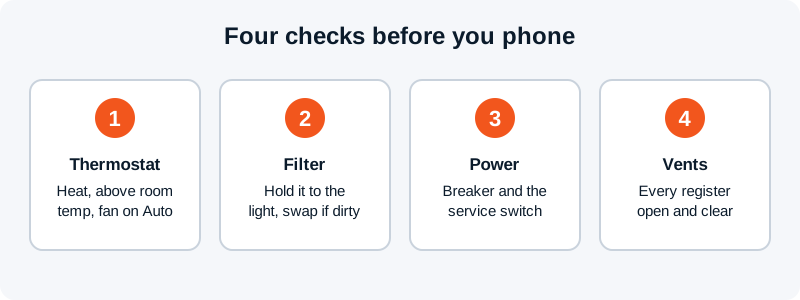
- Thermostat settings. Confirm it's set to heat, that the target is above the room temperature, and that the batteries aren't fading. A thermostat stuck on cool or off will never ask for heat.
- Fan setting. Look for a switch marked ON and AUTO. On ON the blower never stops, so between heating cycles it pushes room-temperature air through the registers, and that air feels cool on your hand even though nothing is broken.
Filter, power and vents
- Air filter. Pull it out and hold it up to a light. If you can't see light through it, change it, because it's choking the furnace. Check the size printed on the old one, and point the arrow toward the furnace.
- Power. Check the breaker and the service switch near the furnace. A furnace without power can sit there with a dead display.
- Supply vents. Walk the house and make sure the registers are open and nothing is parked on top of them.
Set the fan to AUTO and give the furnace five minutes. A dirty air filter is the most common reason for cold air from a furnace, because a dirty filter starves the furnace of air and lets the heat exchanger run hot.
Done all that and it still blows cold? You're past the do-it-yourself part. 24/7 furnace repair is the page to read when you want a local pro on the way.
Symptom, likely cause, what to do
This table matches what you notice to the usual suspect. It's a starting point, not a diagnosis.
| What you notice | Likely cause | What to do |
|---|---|---|
| Air is room temperature all the time | Fan set to ON, or the burners aren't lighting | Switch the fan to AUTO and wait a few minutes |
| Warm for a minute, then cold | A sooty sensor, or the limit switch is shutting the burners off | Replace a dirty filter, then phone if it repeats |
| Starts, runs briefly, quits, repeats | Short cycling from poor airflow | Check the filter and open every vent |
| Clicking but nothing lights | Igniter or valve fault | Phone a professional |
| Water near a high-efficiency furnace | Clogged condensate drain | Switch the furnace off and phone a pro |
| Some rooms cold, others fine | Ductwork or damper fault | Check the registers, then phone if it persists |
| Blinking light on the control board | A stored fault code | Count the flashes and pass the pattern along |
Cold from the first second?
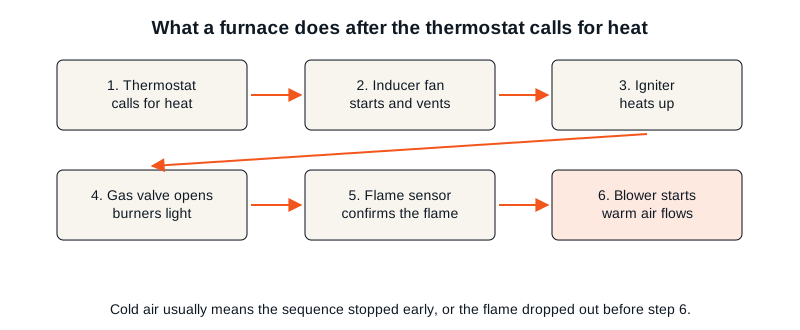
The burners never lit. The thermostat asked for heat and the inducer fan spun up, and the blower may even have started, yet nothing ever lit. A one-way trip like that usually points to a cracked hot surface igniter, a gas valve that didn't open, or a control board that locked the furnace out after a failed start.
Gas furnace or oil furnace?
A gas furnace still runs on electricity, so a tripped breaker or a dead control board can look just like a gas problem. Oil units fail differently: an empty tank, a clogged nozzle or a weak ignition transformer. Look at the thermostat settings a second time too, because an overnight setback schedule can make a working furnace look like a breakdown.
Warm for a minute, then cold
Pretty common, this one. It confuses people because the furnace clearly worked a minute ago. The burners light and the heat exchanger warms up, then the burners drop out and the board shuts the gas off so the air never gets hot.
A sooty flame sensor
The usual culprit is a flame sensor wearing a coat of soot. It's a thin rod that sits in the fire and tells the board the fire is real. When it can't see a fire it assumes there isn't one, closes the valve a few seconds later, and the burners go dark while the blower keeps right on running.
Overheating and short cycling
Overheating does the same thing. Closed registers or a clogged filter choke the airflow, the heat exchanger runs hot, and the limit switch cuts the burners to protect the furnace. A furnace that starts, runs a few minutes and quits, over and over, is short cycling, and that wears parts out faster than normal running does. A stuck or failing limit switch can keep the burners off even after the furnace cools, and one that trips again and again points to poor circulation a professional should trace.
A clogged condensate drain
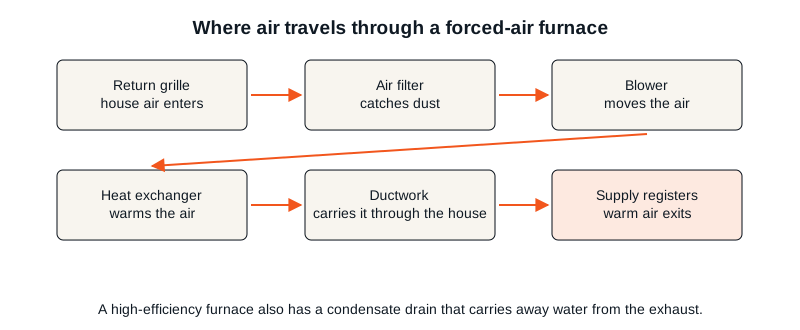
High-efficiency models squeeze so much heat out of the exhaust that the gases cool and turn into water called condensate. It leaves through a small drain line into a trap, a floor drain or a pump. When the line clogs or freezes, a safety switch shuts the furnace down, sometimes mid-cycle.
Some models even blow cold air when the drain backs up, so know what to look for:
- Water pooled around the base of the furnace
- A full trap, the plastic fitting that should be empty
- A stopped pump, if a condensate pump moves the water
Switch the furnace off, and don't pour chemicals into the line. Keep the area around it clean and clear, and leave the rest to a technician to protect the home.
Ductwork and rooms that stay cold
Different story, really. If the nearest register delivers warm air, the trouble may be in the ductwork. A closed damper, a disconnected run or a leaking duct in the attic can leave one end of the house freezing while the furnace does its job just fine.
Open every supply register and clear anything blocking the return grille. If one room stays cold after that, mention it on the call.
Error codes and the pilot light
Modern furnaces report their own faults. A small light behind the access door flashes in a pattern, and the label inside the door usually explains it for that make and model. Count the flashes, note them and give the pattern to the dispatcher. Don't reset the furnace again and again hoping the code clears, because a repeated lockout means a safety device is doing its job.
Older furnaces with a standing pilot light throw people off. A lit pilot only means that small fire is going, and the main burners are a separate step. A worn valve or a bad thermocouple can leave the pilot burning while the blower pushes out cold air. Relighting is fine when the label walks you through it, but if it won't stay lit, stop there.
What a technician checks first
Nobody guesses here. A pro reads the blinking code on the control board and watches the startup from the inducer through to ignition. Then comes the igniter, the flame sensor (cleaned or replaced), the limit switch and the gas valve, and that order is why most of these calls wrap up in a single visit.
Cold even after a new filter?
Don't count on it. A new filter fixes airflow trouble and nothing else, so when the burners aren't lighting or the sensor is sooty, swapping filters changes nothing. Wrong-size air filters, or ones in backwards, can leave you short on air as well. Both the filter and that sensor are standard items on a yearly visit, and our write-up on furnace preventative maintenance lists what a technician checks before winter.
Chilly house, cool vents, no patience left? Phone (833) 749-5188 and say when the air turns cold. Direct HVAC Pros is the referral line, not the contractor, so the number connects you with a verified local pro, who quotes the repair before any work starts. Someone answers at any hour. If you smell gas at any point, leave the house and call from outside.
Quick answers
Why is my furnace blowing cold air when the heat is on?
The blower is running but the burners aren't lit or have shut off. Common causes are a fan set to ON, a dirty filter that overheated the furnace, a dirty flame sensor, an igniter or gas valve fault, or a clogged condensate drain on a high-efficiency model.
Is it dangerous if my furnace is blowing cold air?
Cold air by itself isn't a safety problem, but a house that keeps cooling is a problem in freezing weather. If you smell gas, leave the house and call your gas utility or 911 from outside before you do anything else.
Furnace still blowing cold? Call.
Tell the dispatcher when the air turns cold and what you can hear from the unit.