How to Tell If You Have a Heat Pump
Go look at your thermostat.
Then read the label on the outdoor unit. Those two checks settle it for most homes, they take about five minutes, and you don't need to phone anyone. If a check doesn't give you a clear answer, the next one will.
Six checks, in order
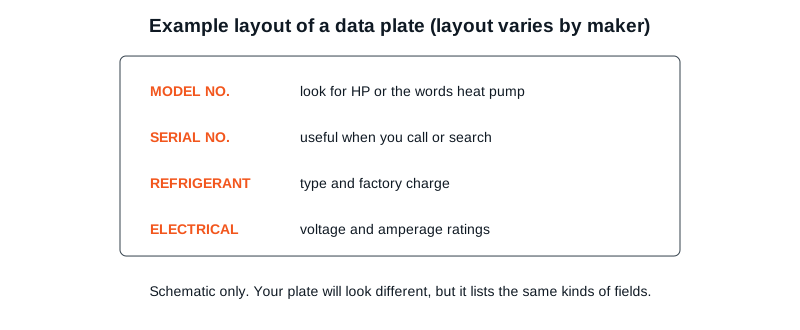
- Read the nameplate. Find the sticker on the side of the outdoor cabinet. That data plate lists the model number, the serial code, the refrigerant and the electrical rating. Plenty of makers print "heat pump" right on it, or put HP in the model number. Nothing there? Search the full number, and the product page will name the type.
- Look for the Energy Guide label. Some equipment ships with a yellow sticker. On a heat pump it lists a heating rating (HSPF or HSPF2) next to the cooling rating (SEER or SEER2), while a standard AC shows only one rating. It often gets thrown away at install, so don't count on finding it.
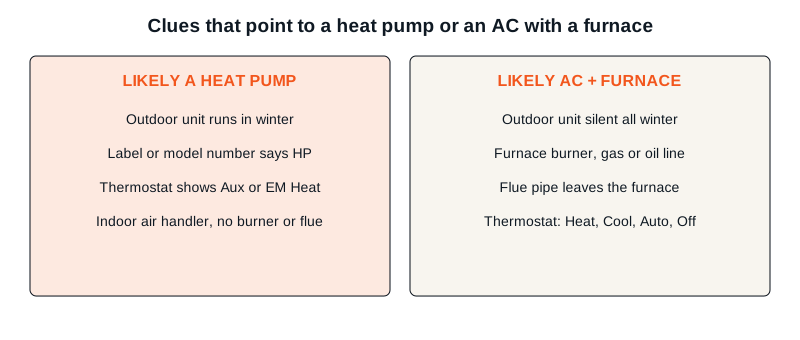
- Watch it in winter. A heat pump runs outside while the house heats, with the fan turning and cold air coming off the top, but a plain AC paired with a furnace sits silent until summer. You'll hear the difference. A little steam or frost on cold, damp days is just the defrost cycle.
- Check the thermostat. A setting called Emergency Heat or EM Heat, or a light marked Aux, almost always means a heat pump. Aux heat is the backup that powers the electric elements when the heat pump falls behind. Plain AC setups usually offer only Heat, Cool, Auto and Off. Smart thermostats bury this in a menu, so hunt around for the system-type settings.
- Look inside. A furnace has a burner, a gas or oil line and a flue pipe, and a heat pump has none of those, only an air handler with a blower and a coil, often with electric strips for backup. A wall-mounted indoor unit with no ducts is a ductless mini-split. That's a heat pump too.
- Run it. Set the thermostat to heat and bump it up a few degrees. Go outside and listen: in heating mode the outdoor fan should start, and warmth should reach the vents within a few minutes. Cool output that lasts, a silent outdoor unit or heavy ice on the coil means something's wrong.
If step six goes wrong, that's the situation emergency heat pump repair exists for, and the dispatcher takes it from there.
What you saw, and what it means
Match it up. Here's the cheat sheet, and it's pretty much all you need for a first guess.
| What you see | What you probably have |
|---|---|
| Outdoor unit is active in winter and blows cold air while the house heats | A heat pump |
| Outdoor unit silent while a gas furnace runs | An air conditioner with a furnace |
| Thermostat shows Emergency Heat or Aux | A heat pump |
| Wall-mounted indoor units and no ducts | A ductless mini-split, usually a heat pump |
| Outdoor heat pump, gas furnace indoors | A dual fuel system |
That last row trips people up. In a dual fuel setup the heat pump works with a gas furnace indoors as its backup, so the outdoor unit is a heat pump even though a furnace is sitting right there in the basement.
Write down what you find, because the notes are handy on a service call. Heat pumps come in many shapes, from slim wall units to big outdoor cabinets, and heat pumps look much alike from the street. An HVAC pro can tell them apart quickly, and most homes with heat pumps use the thermostat settings described above, including backup heat and auxiliary heat. Gas homes behave differently, because a gas-fired furnace has burners and a flue while the outdoor unit may only cool.
The reversing valve clue
The one part that separates a heat pump from an air conditioner is the reversing valve. It flips the direction of the refrigerant so the same outdoor unit can cool in summer and heat in winter. Here's the catch: it's tucked into the outdoor cabinet, and most homeowners won't see it or know it when they do. So treat it as the reason the other clues work, not as something to hunt for yourself.
A technician can spot it in seconds. It's a small brass or steel cylinder with copper lines running into it, and an AC has no such part. If you ever hear a whoosh from the outdoor unit when the system switches modes, that's the valve changing the flow.
Can an air conditioner heat too?
Only if it's a heat pump. If it isn't, no. A standard air conditioner pushes warmth out of the house and can't reverse, while a heat pump has a reversing valve that flips the flow, which is why one outdoor unit cools in summer and heats in the shoulder months. Window and portable air conditioners that say "heat" usually use an electric element instead, which is a different thing.
Heat pump or AC: the difference
What each one does
Both machines move warmth with refrigerant, and both cool a home the same way. The difference shows up when you need heat. A heat pump can run the process backwards, pulling heat from the outside air and carrying it indoors, while an AC only pushes heat out. Because a heat pump moves warmth instead of burning fuel, it can be a very efficient choice for heating and cooling, and many models come with higher efficiency ratings than older equipment.
That also explains the vents. The air from a heat pump is warm but not hot, so it often feels cooler on your hand than furnace air, even when the system is working properly.
Cold-climate models
Standard heat pumps lose capacity as temperatures fall, which is why many homes pair one with backup heat. Cold-climate heat pumps are built to keep heating well below freezing. If winters are harsh where you live, check the maker's specifications for how it performs in low outdoor temperatures.
Why many homes have a heat pump
Heat pumps are common in mild regions and growing everywhere else. A heat pump provides heating and cooling from one system, so a home needs one outdoor unit and one indoor unit instead of a furnace plus a separate air conditioning system. Because heat pumps move heat instead of making it, they use far less electricity than electric resistance heating, and a high efficiency unit can trim energy use further.
Efficiency and comfort
Many of these systems run year round, which means the equipment earns its keep in both seasons. Comfort is the other draw: heat pumps tend to run longer at lower output, which keeps the temperature steadier than a system that blasts and stops, even during the coldest weeks, when the weather puts the equipment at its limit. Ratings help you compare, so look at the heating rating and the cooling efficiency on the nameplate or the product page.
- One system for heating and cooling
- Lower running cost than baseboard or furnace elements in many homes
- Steadier comfort from longer, gentler cycles
Dual fuel and hybrid systems
Dual fuel systems
A dual fuel system pairs an outdoor heat pump with a gas furnace indoors. The heat pump carries the load in mild weather, and the furnace takes over when temperatures drop. These setups can fool the checks above, because a heat pump paired with a furnace may not run at all when you turn on heat in freezing weather. Read the nameplate and look at the thermostat settings before you decide.
The fuel choice matters in these setups. The heat pump uses electricity, the second source burns gas, and the controls decide which one runs based on the weather and energy prices, which can save money across the heating season and keep the home comfortable on the coldest days.
- Outdoor unit: labeled HP
- Indoor equipment: a furnace with a gas line and a flue
- Thermostat: may show a fuel setting or an outdoor-temperature switchover
Ductless mini-splits
Wall-mounted indoor units connect to an outdoor condenser with refrigerant lines. The condenser unit is the part to read, and nearly all of them are heat pumps, so the same clues apply: check the nameplate and run it in heat mode.
Why it matters
A heat pump fails differently from a furnace or a plain AC.
The technician needs to know which one you own, so the right person shows up at your door with the right parts in the truck. A heat pump can stall in defrost mode, a furnace can lock out on a flame sensor, and an AC can't heat at all.
Knowing your system also helps with maintenance. A heat pump runs all year, so it benefits from a filter change every few months and a yearly check, and it helps to keep the outdoor unit clear of leaves and snow. Heat pump and fuel-burning equipment also need different parts and know-how, which is why a pro matched to your equipment matters. Once you know what you've got, our post on the heat pump heater blowing cold air shows what the air is doing and what that usually means. Heat pump stopped heating? Call (833) 749-5188 and tell the dispatcher what you found on the nameplate and the thermostat, and a verified local pro gets matched to your equipment. Direct HVAC Pros is a referral service, so the connection costs you nothing, and the pro quotes the job.
If the checks conflict
If the clues disagree, a technician can confirm in minutes. They'll read the nameplate, look at the equipment indoors and check for a reversing valve. During the visit they can also explain your heat pump thermostat, including the heat setting that matters most in the heating months, and they'll almost certainly tell you whether you own a heat pump, an AC or a hybrid arrangement.
What to share with the pro
- The labels on the thermostat, such as an Aux setting
- The details from the nameplate
- Whether the condenser runs when the system heats
- Any ice, noises or smells
Share those details when you phone, and ask the dispatcher to match you with a pro who works on heat pump systems and your type of HVAC system.
Quick answers
What does aux heat mean on a thermostat?
Aux, short for auxiliary, is backup heat that comes on automatically when the heat pump can't keep up. It usually runs electric heat strips in the air handler. It's different from emergency heat, which you switch on yourself.
Can I tell from the model number?
Often, yes. Many makers put HP in the model number or print the words heat pump on the nameplate. If it isn't obvious, search the full model number or look for the Energy Guide label.
Unsure and cold? Call.
Share what you found on the nameplate and the thermostat.