Heat Pump Heater Blowing Cold Air
Sometimes that's normal.
A few minutes of cool air from your heat pump in winter is usually the heat pump doing its job. Air that stays cool is a different story, and the difference comes down to how long it lasts, what the outdoor unit is doing and whether the backup is stepping in.
Normal cool air
Most complaints about a heat pump blowing cold air land in one of three buckets, and the first bucket isn't a problem at all. Heat pumps heat with warm air, not hot air, so they run longer than a furnace, and the air they deliver is noticeably cooler than furnace air. A vent that feels cool to your hand can still be heating the home just fine, because the supply air is often only a little warmer than your body temperature.
A furnace burns fuel and delivers air well above that. A heat pump doesn't make heat that way. It moves heat from the outside air into your home, so the vents feel lukewarm even while the whole house warms up. The better test is the thermostat: if the room temperature is climbing toward the set point, the heat pump is working.
The weather matters too. In cold weather there is less heat out there to absorb heat from, so the system leans harder on its backup. That is why the same heat pump that felt warm in October can feel underwhelming in January. Bucket two is the defrost cycle and bucket three is a real fault, so if your heat pump is blowing cold air for only a few minutes, read the next section before you worry.
Check the thermostat's mode before anything else. In winter a heat pump should run in heat mode, and many thermostats also offer cool, auto and emergency settings. On auto, a heat pump can switch to cooling for a stretch on a mild afternoon, and cold air comes out of every vent until the house settles. If the display shows a different mode than you expect, correct it and give it ten minutes before you decide anything is broken.
Why the air turns cool for a few minutes
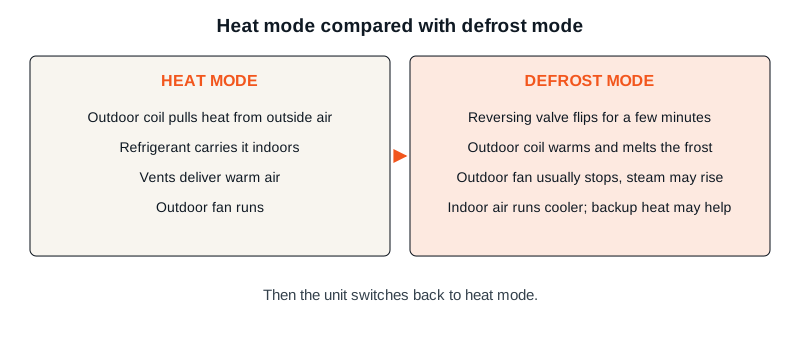
In cold, damp weather frost builds up on the coil outside. Every so often the system switches into defrost mode. The reversing valve changes the direction of the refrigerant, hot refrigerant melts the frost and the fan usually stops. That reverse cycle is a normal part of heat pump operation.
For a few minutes the air inside runs cool, and you may see steam rising off the cabinet. That looks alarming but it is only melted frost leaving the coil. Then the heat pump returns to heating mode. Many systems switch on electric auxiliary heat during defrost mode to soften the dip.
A light coat of frost that comes and goes is normal. Thick ice that stays for hours is not, and neither is a cycle that never seems to end. Those point to a failed control board, a bad sensor, a leak or restricted airflow.
Expect a whoosh when the valve reverses and a quiet fan for a bit. A loud grinding noise, or a compressor that hums without starting, isn't ordinary.
In freezing, damp weather the cycle can repeat several times a day, which is why a heat pump may seem to blow cold air at about the same time each evening.
Reading the symptoms
Here's the thing about vents: they feel cool even when everything works, so sort what you notice by symptom. Match the symptom, then read across. None of this replaces a pro with gauges, but it shows whether you're looking at normal cool air or at something that deserves a phone call tonight instead of next week.
| What you notice | What it usually means |
|---|---|
| Cool for a few minutes, steam at the cabinet | A normal reverse cycle |
| Lukewarm all the time, house never catches up on very cold days | The heat pump is at its limit, or the backup isn't coming on |
| Cold air the whole time, fan running outside | A weak refrigerant charge, or a stuck valve |
| Cold air, and the cabinet outside is silent | A failed capacitor, contactor or compressor |
| Cold air from only some vents | A duct or airflow problem, not the heat pump |
| Cold right after someone touched the controls | Thermostat on cool or auto, or the fan set to run continuously |
Before you phone, run through a short list. None of it needs tools.
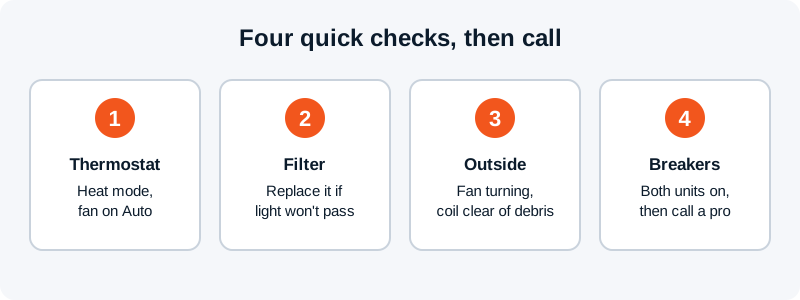
- Thermostat settings: confirm the setting is heat, not cool or fan only, with the target above the room reading and no schedule or hold overriding it.
- Air filter: a clogged filter chokes airflow and makes the air feel weak and cool. Replace it if it's dirty.
- Outside: from a safe distance, see whether the fan is turning when the heat pump calls for heat.
- Coil: look for leaves, snow or debris packed against the cabinet and clear them gently.
- Breakers: check the breakers for both the condenser and the indoor equipment.
Don't open the cabinet or chip ice off the coil with a tool. You can damage the coil, and a capacitor can hold a charge.
A dirty filter deserves a second look. It restricts airflow, the coil can't hand over its heat, and the heat pump feels weak even when nothing else is wrong. If it looks dusty, swap it and let it run for an hour before you decide. If only one room stays cold, open every register and keep interior doors from blocking the return; that points at ductwork, not the equipment.
Faults that need a technician
A heat pump blowing cold air with the thermostat clearly set to heat usually traces to one of four things, and none of them is a repair anybody should guess at from the couch.
- A reversing valve stuck in the cooling position. The system moves heat the wrong way. It pulls warmth out of your home instead of pushing it in, and nothing at the wall or the breaker will change that.
- A weak charge. A refrigerant leak leaves the system without enough charge to carry heat, so it runs and runs and never warms anything. Topping it off isn't a homeowner job, because refrigerant levels take gauges and a licensed pro.
- A failing compressor or fan motor. The outside half stops doing any work. You hear nothing from the yard, or a hum with no fan turning.
- A control board problem. The board runs the timing and tells the valve when to switch. When it fails, the heat pump can get stuck in defrost or never enter it.
When it's one of those, the emergency heat pump repair page explains how a verified local pro gets matched to your equipment, whatever the hour. Calling beats guessing.
Stop and switch the system off at the wall control and the panel if you smell burning, see sparks or find the breaker tripped again after a reset. That is an electrical safety problem, so call a professional before you restart anything.
Backup heat and emergency heat
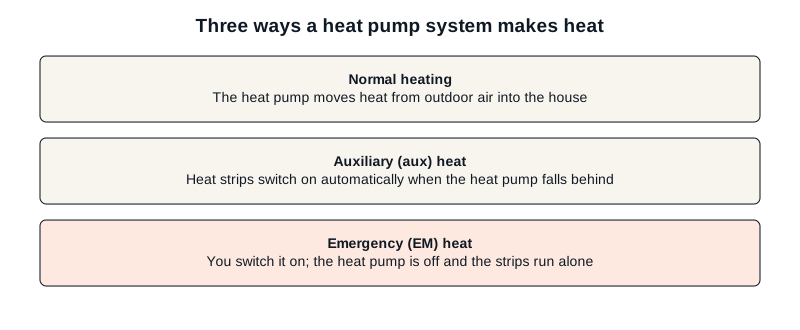
These get mixed up, so here's how they differ. Auxiliary heat, often labelled aux on the thermostat, is the backup that comes on by itself when the heat pump falls behind. In most homes it's a set of electric heat strips inside the air handler, and in a dual-fuel home it's a gas furnace.
Emergency heat is different. The EM heat setting switches the heat pump off and runs only the backup, usually the electric strips. Anything blowing cold air on that setting points at the strips and not the heat pump: a tripped breaker, a burned-out element or a failed sequencer.
Freezing weather makes this obvious. Heat pumps lose capacity as the temperature falls, and past a certain point the heat pump alone can't keep up. Air that feels cooler as it gets colder, with the backup never kicking in, means the strips or their controls have a fault, and older heat pumps that weren't built for cold climates make that gap more obvious. Mention which setting you're on when you phone, because it saves everybody a trip.
When to call a pro
A technician starts at the controls, then walks outside to look at the equipment itself. Most visits end with a diagnosis on the first trip.
What a pro looks at
- The fan motor, the capacitor, the coil and any ice that has built up
- The defrost controls and the reversing valve that decides which way heat flows
- Refrigerant pressures and the lines, looking for a leak
- Whether the backup comes on when it should
- The indoor blower and its cabinet
Still cold after the defrost window has passed? Call (833) 749-5188 and describe what the system is doing, and a verified local pro gets sent to test it. Many repairs finish in one visit when the failed part is a common one, such as a capacitor, a contactor or a sensor, and when a part has to be ordered the pro says so. Direct HVAC Pros is a referral service, so the connection is free and the pro quotes the work. Not sure you even own a heat pump? Work out what you own first, then call as soon as the air stays cold.
A short description speeds things up. Mention the thermostat setting, how long the air has been cool, whether the fan outside is turning, any ice on the cabinet and any noises you can hear. If your home is dropping toward freezing, say so, because it affects how quickly the visit is scheduled.
Regular maintenance helps too. A fresh air filter and a clear space around the cabinet head off many of these calls, and a yearly visit from an HVAC technician catches a weak part before the first freeze. Heating and cooling equipment of every kind benefits from the same routine.
Quick answers
Why is my heat pump blowing cold air while it's set to heat?
If it lasts only a few minutes, the unit is probably in defrost mode. If it stays cool, the cause could be low refrigerant, a stuck reversing valve, a failed outdoor fan or compressor, or backup heat that isn't switching on.
How long does the cool-air stretch last?
It varies by model and by weather, and the manufacturer's manual is the best source for your unit. As a rule, a normal cycle is short and the unit returns to heating on its own. A cycle that keeps going, or ice that stays on the unit, deserves a technician.
Still cool after the frost clears? Call now.
Say how long the air has been cool and what the system is doing.