What Is Ductless Heating and Cooling?
No ducts? No problem. Ductless heating and cooling means you get one outdoor unit, one or more slim heads mounted up on your walls, and a thin bundle of refrigerant line, power cable and drain tube running through a small hole between them, which is exactly why people call it a mini-split.
Nearly every ductless system is a heat pump, so the box that cools your bedroom in July is the same box that warms it in January, and you don't need a furnace anywhere in the picture. Some people write it as a mini split with no hyphen. It's the same thing.
Is it right for your home?
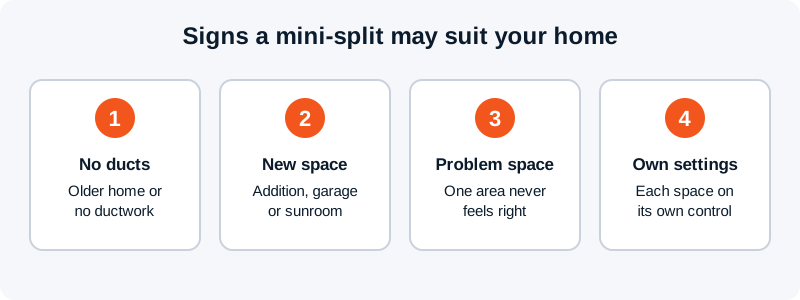
That depends on what your house looks like, because ductless shines wherever ducts don't exist or can't easily go, like an addition, a converted garage, an older home that never had ductwork, or a single space that never feels right no matter what you do with the thermostat. You aren't tearing into walls to get there, and you aren't conditioning spaces that nobody's using, which is a big part of why people pick it and one reason it can show up on your energy bills.
- Additions, garages and sunrooms that existing ducts can't reach
- Houses that were built without ducts
- A bedroom or office that never matches the rest of the house
- Homes where you'd like every space on its own setting
If your home already has air conditioning, a mini-split can still earn a place in it. Many families keep their existing HVAC system for the main floor and add a ductless head for the one space the ducts never served well. That keeps the cost down and the whole home more comfortable, without opening up the walls or rebuilding the ducts you already have.
Whole-home comfort is possible too, though you'll need enough indoor heads to cover every area, and that's exactly where the numbers start to add up. Plenty of homeowners start with a single mini-split in the space that bothers them most and add more later. If one you already own stops working, the ductless heating repair page explains how the dispatch line matches you with a verified local pro.
Ductless against central, side by side
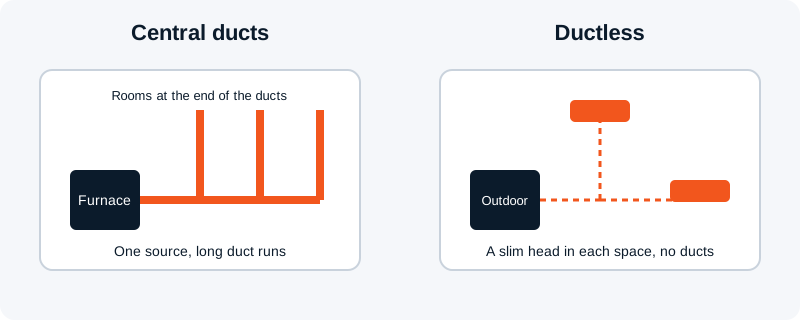
The biggest difference is how the air travels, since central systems push it through ductwork to every room from one furnace or air handler while ductless equipment sits right in the spaces it serves. You'll notice the gap most in homes where ducts run through a hot attic or a cold crawl space and lose warmth along the way, because that's energy you paid to make and never feel. Simple as that.
| Feature | Ductless mini-split | Central forced air |
|---|---|---|
| Ductwork | None | Required |
| Temperature control | Space by space | Usually one thermostat for the house |
| How it heats | Electric heat pump | Gas, oil, electric furnace or heat pump |
| Fits best | Additions, garages, older homes without ducts, single spaces | Whole homes that already have ducts |
A traditional split system, with a condenser outside and an air handler inside, still needs ducts to move the air. A mini split skips that step, which is the whole idea. It's also why people comparing a mini-split against central air are really comparing how conditioned air gets from the equipment to the space.
Efficiency is part of the comparison too. Ductless systems avoid duct losses entirely, and mini splits are often more energy efficient because they condition only the spaces in use. Look at the efficiency ratings on each model, and ask your installer to compare them for your home.
How the pieces work together
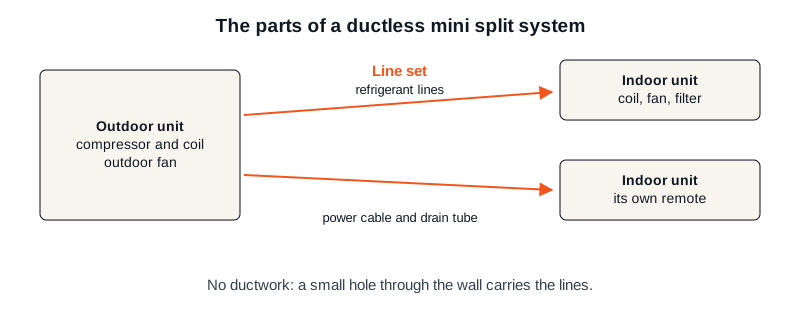
Your outdoor unit holds the compressor and a coil, while each indoor unit holds a coil, a fan and a filter. The two halves connect through a line set, a pair of insulated copper refrigerant lines, plus a power cable and a drain tube, and all of it passes through a small hole so nobody has to build ductwork.
- The condenser: the compressor, a coil and a fan
- The indoor head: a coil, a fan and a filter
- The line set: copper lines, a power cable and a drain tube
A complete mini split system therefore has three parts. Manufacturers also call it ductless HVAC or ductless air conditioning, so don't be thrown by the different names. They all describe the same kind of equipment.
Is it a heat pump?
Almost always, yes. A ductless system moves heat instead of burning fuel, which is how a single condenser manages to warm your space in winter and cool it in summer. A few models only cool, so check the label if you're not sure what you've got. Plenty of ductless heat pumps are sold today, and they compete with both window units and ducted air conditioners.
Cold-climate versions are built to keep heating when it's well below freezing, and plenty of them run a defrost cycle to clear frost off the outdoor coil, so a few minutes of steam isn't cause for panic. If you live somewhere cold, look for a model rated for cold-climate use and check the maker's specifications for how it performs at low temperatures instead of relying on a general claim. Energy Star also publishes a neutral overview if you want one.
Heating mode and cooling mode
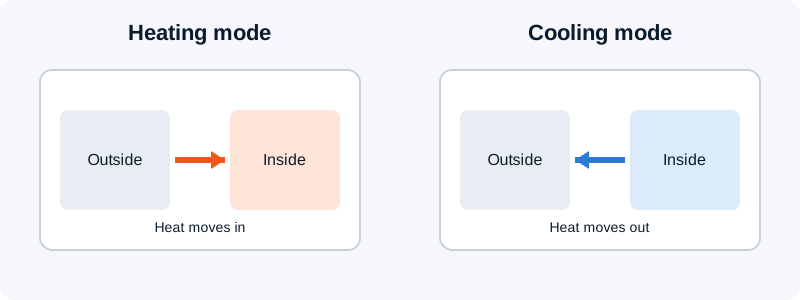
In cooling mode the system pulls warmth out of the room and dumps it outside, the same way an air conditioner does. In heating mode a reversing valve flips the flow so the system pulls heat out of the outdoor air and carries it in, even on a day when you'd swear there's none left to find. That reversal is the only real difference between a cooling-only model and one that also heats.
What an inverter does
Most systems use an inverter-driven compressor that changes speed rather than slamming on and off, so the temperature stays steadier through the day and you'll barely hear it running. Quiet, mostly. An inverter that eases up and down instead of cycling hard is also gentler on the parts, and it's the feature most people notice first when they switch from an older window air conditioner.
Zones, and why each room gets a say
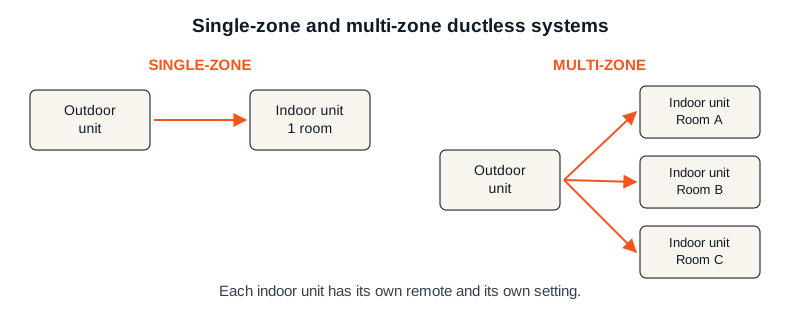
Every head has its own remote, so your bedroom can run cool while the living area stays warm, and nobody has to fight over a single thermostat in the hallway. That's zoning: each area gets its own setting, which ducted equipment usually can't match without extra dampers and controls. An area can be one bedroom or a whole open living space, depending on where you place the heads. Most heads are wall mounted, though ceiling cassettes and floor models exist. That control lets you warm or cool individual rooms instead of the entire home on one setting, and the control sits in your hand, not in a hallway.
Single-zone and multi-zone setups
A single-zone system pairs one head with a condenser. A multi-zone system connects several heads to the same condenser, which is the setup you'd pick if you're covering more than one space. Pretty flexible.
Sizing and what to expect from an install
Sizing matters more than people expect. A head that's too small for the space runs flat out and still falls short, and one that's too big can cycle on and off instead of settling into a steady speed. A qualified installer sizes each ductless head to its space, looking at the square footage, windows, insulation and how the space is used.
A typical install has a condenser on a pad or a bracket, an indoor head mounted high on the wall, and a short run through the siding for the line set. It's work for a licensed pro, because it involves refrigerant and electrical connections. Ask each installer:
- How they size each head: room by room, not by a rule of thumb
- What the quote includes: equipment, labor, the line set and the electrical work
- What the warranty covers: parts, labor and how long each lasts
- Where the heads and the condenser will go: get it in writing
What it costs and saves
Prices for ductless installs vary by region, by brand and by how many zones you want, so this page doesn't quote any. Energy savings are common because each space is conditioned only when it needs to be and there is no duct loss, but how much you save depends on your house, your climate and your habits. Ask for the total cost in writing, and ask how much of it is equipment and how much is labor. A more efficient model costs more up front and less to run, so compare energy efficiency ratings on the equipment, not just the sticker price.
Upsides and trade-offs
Here's the honest scorecard. Nothing on the right side is a dealbreaker for most people, but it's the stuff you'd rather hear now than after the first installer quote lands on your kitchen table and you're doing math you didn't plan on.
| What's good | What to weigh |
|---|---|
| No ducts to install, seal or clean | The indoor heads are visible on a wall, ceiling or floor |
| Zoned comfort, so only the areas in use get conditioned | Heating a whole house usually takes several heads, which adds up |
| A quiet inverter compressor that holds a steady temperature | The filters need regular cleaning to keep performing |
| Heating and cooling from one electric system | Installation and refrigerant work belong to a licensed professional |
Care, and common ductless faults
Maintenance on a ductless system is light, but it isn't zero. Wash or vacuum the indoor filters on the schedule in the owner's manual, keep the area around the condenser clear of leaves, snow and anything stacked against it, and make sure the drain tube is dripping where it should. A yearly check by a technician catches a dirty coil or a weak part before it turns into a no-cooling call in July. Each of the indoor units has its own filter, so a multi-zone setup means a few extra minutes of cleaning.
Ductless systems are dependable, but when they fail it's usually in a way that needs a technician with the right gauges and parts, not a screwdriver and a video. Typical faults look like this:
- Cool air in heat mode: the head blows cool air when you want warmth
- Water leaks: drips under the head, often from a clogged condensate drain
- Ice or no start: the condenser carries heavy ice or refuses to start
- Error codes: a flashing light and a code you can't decode
A remote that no longer controls anything rounds out the list. An HVAC technician who works on ductless systems knows the brand error codes and the cooling circuit, so ask for one when you call. None of it's fun.
Questions people ask
Can a ductless system warm a room as well as cool it?
Yes, as long as it's a heat pump model, and most are, because one outdoor unit can cool you in summer and heat you in winter simply by reversing the flow of refrigerant.
Can ductless warm a whole house?
It can, if you've got enough indoor heads to cover every area, though plenty of homeowners use it for just one space (an addition, a garage, a bedroom) and leave a central system running everywhere else in the house.
Does ductless use gas or electricity?
Electricity. It moves heat instead of burning gas, oil or propane, so there's no flame anywhere in the system.
When a unit stops heating, the next step is the repair page, and the number is (833) 749-5188. Direct HVAC Pros refers the call to a verified local pro and doesn't charge you for the connection, and a person answers overnight and on weekends.
Mini-split acting up? Ring us.
Describe what both units are doing and we'll connect you with a pro who works on them.