Ductless Heating Repair and Ductless Mini Split Repair Services
A mini-split that stops heating, blows cool air when it should be warm, leaks water, throws an error code or will not turn on needs a technician who works on ductless units. One call connects you with a verified local pro, day or night.
Direct HVAC Pros is a referral service and not a contractor. Call (833) 749-5188, tell the dispatcher what the indoor and outdoor units are doing, and you are matched with a pro who diagnoses the unit, quotes the repair and does the work.
Online nowFree assessment on the call. Open nights, weekends and holidays.
Expert ductless mini-split repair for every system
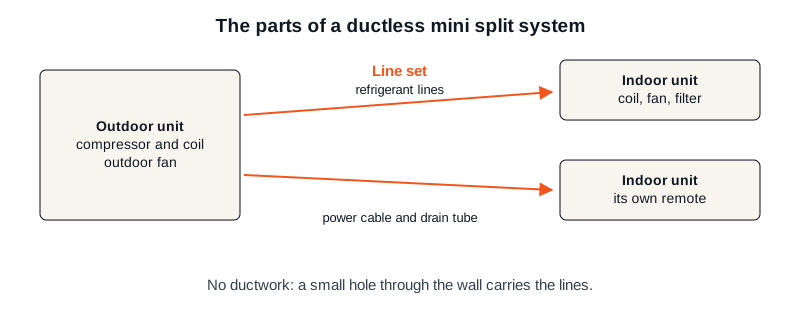
A mini-split has no burner and no ducts to inspect. Comfort comes from a refrigerant circuit linking one outdoor unit to one or more wall-mounted indoor units, so the faults hide in places a heating tech never looks.
That is why ductless repair is its own skill.
Expert mini-split repair means knowing the indoor coil, the condensate drain, the communication wire between the units and the inverter board in the outdoor cabinet.
Nearly every ductless unit is a heat pump, so the same refrigerant tools apply as for heat pump repair, plus the brand-specific error codes and wiring that ductless equipment adds.
The pros we connect you with work on all the common models and can repair any issue, from a clogged drain to a failed compressor.
Technicians in our network repair ductless units and repair heating equipment of every kind, so one call covers the whole home.
If you are still learning how your ductless system fits together, our guide walks through the pieces. Knowing which part is which makes the call to the dispatcher faster.
When you call, a dispatcher answers any hour of the day, including nights, weekends and holidays, and matches you with a verified local pro who offers mini-split service in your area.
It speeds things up if you have the brand and model, any error code, and a short description of the symptoms ready. The pro finds the fault, explains the repair and sets the price before any work starts.
Signs your ductless system needs repair
Watch for these signs:
- Cool air in heat mode: the indoor unit blows cool or room-temperature air
- Water leaks: drips from the indoor unit or water running down the wall
- Error codes: a blinking light, or a code on the display
- Heavy ice: ice on the outdoor unit that does not clear
- Silent outdoor unit: the compressor does not start
- Odd smells and noises: a musty smell, rattling or a loud hum from the indoor unit
- Dead remote: the remote has power but the unit ignores it
Any one of these is worth a call.
Several at once usually point to a refrigerant or control problem, and the sooner a technician looks, the less strain the compressor takes.
This table matches what you notice to the usual cause. It is a starting point, not a diagnosis, and none of it replaces a technician with gauges and the maker's code chart.
| What you notice | What it often means |
|---|---|
| Cool air for a few minutes, outdoor unit steaming | A normal defrost cycle |
| Cool air all the time while set to heat | Low refrigerant, a dirty coil or a stuck reversing valve |
| Water leaking inside | A clogged condensate drain or a dirty coil |
| Indoor unit on, outdoor unit silent | A communication fault, failed capacitor or inverter board |
| Heavy ice outside | Airflow blocked, a failed defrost sensor or low charge |
| Weak airflow from the indoor unit | A clogged filter or a failing blower motor |
A short blast of cool air with steam rising off the outdoor unit is usually a normal defrost cycle. The reversing valve flips for a few minutes to melt frost off the outdoor coil, then the unit returns to heating on its own.
Air that stays cool, or ice that never clears, is a fault.
Outdoor unit and refrigerant problems
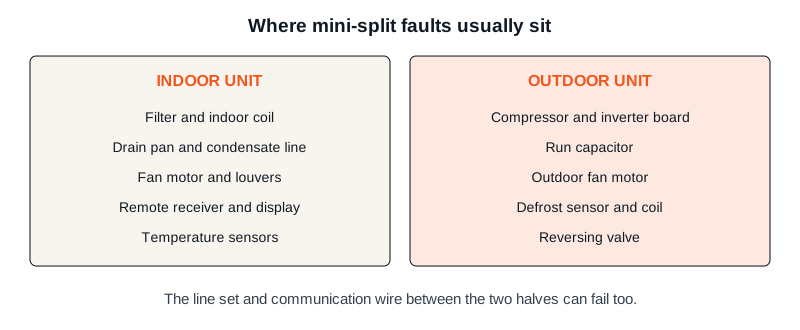
The outdoor cabinet holds the compressor, the capacitor, the outdoor motor, the defrost sensor and the inverter board.
When it will not start, the cause is usually a failed capacitor, a tripped breaker or a communication fault between the two units.
Ductless repair at the outdoor unit
A humming unit with a stopped motor often has a weak capacitor. A silent compressor with the indoor unit still running points to the inverter board or the compressor itself.
Thick ice that stays points to a bad defrost sensor, blocked airflow or low refrigerant.
A refrigerant leak somewhere in the line set leaves the system without enough charge to carry heat, so it runs and runs and never warms the room. Adding refrigerant without finding the leak only delays the next failure, which is why this part is for licensed technicians.
Indoor unit problems
Most indoor faults are about airflow and water. A dirty filter or a coil caked with dust weakens the heat output, a clogged drain sends water down the wall, and a failing blower motor causes rattles and weak airflow.
A musty smell usually means the coil or the drain pan needs cleaning. A failed room sensor can make the unit shut off early, and a stuck valve leaves it cooling in heat mode.
Not sure whether the fault is indoors or outdoors? Describe what you see and hear on the call, and the dispatcher passes it to a technician who can quickly diagnose it.
Ductless inspection and maintenance
A ductless inspection starts with a few checks you can do yourself.
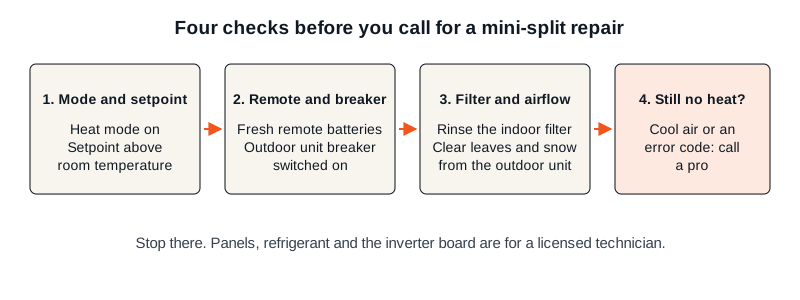
A few minutes of looking can save a visit or at least make it shorter. Work through these in order:
- Confirm the unit is in heat mode and the setpoint is above the room temperature
- Replace the batteries in the remote and point it at the receiver
- Check the breaker for the outdoor unit and reset it only once
- Pull the indoor filter and rinse off the dust
- Clear leaves, snow or debris from around the outdoor unit
- Write down any error code and how many times the light blinks
To reset the unit once, turn it off with the remote, switch off its breaker for about five minutes, then switch it back on and restart in heat mode.
If the error code returns, a part has failed and a pro needs to look at it.
If that does not help, stop there. Opening panels, adding refrigerant and testing the inverter board need a licensed technician with the right gauges.
On the repair visit, the pro starts with the basics and works inward, so you get a clear finding before anything is replaced:
- Check the remote settings, the breaker and the error code against the maker's chart, since every brand flashes its own.
- Pull the indoor cover and inspect the filter, the coil, the drain pan and the blower.
- Check the outdoor unit: the motor, the capacitor, the coil and any ice.
- If the refrigerant side is suspect, connect gauges and test for a leak before adding anything.
- Explain the finding in plain words and quote the repair before a part is ordered.
Regular maintenance matters too.
A yearly maintenance visit catches a dirty coil or a weak part before it turns into a no-heat call in January, and repair and maintenance can often be handled in the same trip.
Between visits, a few maintenance habits keep a system healthy:
- Wash the indoor filters on the schedule in the owner's manual
- Keep the area around the outdoor unit clear of leaves, snow and stored items
- Make sure the drain tube is dripping where it should
- Remember that a multi-zone system has a filter in every indoor unit
Good maintenance keeps the home comfortable and keeps small faults from growing into big repairs.
Ductless installation and replacement
Blower motors, capacitors, sensors and clogged drains are ordinary repairs.
A failed compressor, or a refrigerant leak somewhere in the line set, is a bigger decision, especially on an older unit that is out of warranty.
The pro can lay out both routes, and the choice stays with you. Replacement makes sense when repair costs approach the price of a new unit, or when the same part keeps failing.
Cost follows the failed part, and the pro sets the price, not Direct HVAC Pros. A cleaned drain or a new capacitor sits at the small end, a blower motor or sensor in the middle, and a compressor or leak repair at the large end.
Ask whether an after-hours service fee applies, ask for the quote before work begins, and ask about warranty terms, which vary by company and by job.
The same pros handle installation of new mini-split units, including sizing each indoor unit to its room, and replacement of units that are past economical repair.
Many ductless services, from a quick tune-up to a full replacement, start with one phone call. Pass along the brand, the age and the symptoms so the pro arrives prepared.
For a ductless emergency, such as no heat in freezing weather, tell the dispatcher so the visit is prioritized.
Common questions about ductless services
Why is my ductless unit blowing cool air in heat mode?
Often it is a defrost cycle, which lasts a few minutes, or the unit is set to dry or cool mode. If the air stays cool, the cause can be a dirty coil, low refrigerant or a failed reversing valve, and a pro needs to check it.
Can I fix a leaking mini-split myself?
Wiping up water and cleaning the filter is fine. A leak usually comes from a clogged drain line or a dirty coil, and clearing it properly takes the right tools. Refrigerant work is for licensed technicians only.
How much do ductless repairs cost?
It depends on the fault. Many fixes are small, such as a cleaned drain or a replaced blower motor, while a failed compressor or a refrigerant leak is a bigger job. The matched pro quotes the work after diagnosing it.
Ductless unit down? Talk to a dispatcher.
Describe what the indoor and outdoor units are doing, and a verified local pro takes it from there.