Does Central Heating Use Gas or Electricity?
Usually gas. But not always.
Most American homes run on gas, though electric systems are everywhere and plenty of houses run on oil or propane. So which does a central heating system use? Here's the thing: it depends on what's sitting in your basement or closet, and even a gas system needs some power to run.
Which fuel is yours?
You can usually work it out in two minutes just by looking at the equipment (a flashlight helps). No tools needed.
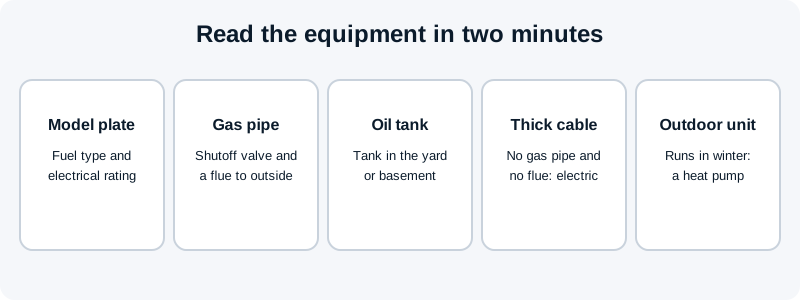
- Model plate: the label on the furnace or boiler lists the energy type and the electrical rating
- Gas or propane: a gas pipe with a shutoff valve and a vent to the roof or an outside wall
- Oil: an oil tank in the basement or yard, plus a line to the burner
- Electric: thick electrical cable and no gas pipe or flue
- Heat pump: an outdoor unit that looks like an air conditioner while the thermostat's set to heat, and that's plain and simple
Whatever you find, tell the dispatcher when you phone (833) 749-5188, because it's what lets them match you with a pro who actually works on that type of system. The same checks work for a boiler, which warms water instead of air.
Gas furnaces need power too
Gas heating isn't independent of the grid. Power matters. The blower motor, inducer motor, igniter, control board and thermostat all run on electricity, usually an ordinary household circuit, which is why a gas furnace goes quiet in a power outage and why a dead control board can leave one cold with the gas flowing fine.
A gas problem and an electrical problem are different jobs, and that's the reason service calls start with gas and power questions. Dead furnace on a cold night? Our central heating repair page explains how the call works.
The main fuel options
Central heating means one heat source serves the whole house. In most American homes that source feeds a forced-air system, where a blower pushes warm air through ductwork to registers in each room. A boiler does the same job with hot water and radiators or floor pipes. Either way, the energy source is a separate choice from the delivery method, which is why the question has more than one answer. Gas central heating and electric systems can both be done well, and gas or electric is mostly a question of climate, utility rates and the house itself. Whatever the setup, the heating systems in most homes come from one of three families: burners, resistance elements or moved heat.
Burning fuel: furnaces and boilers
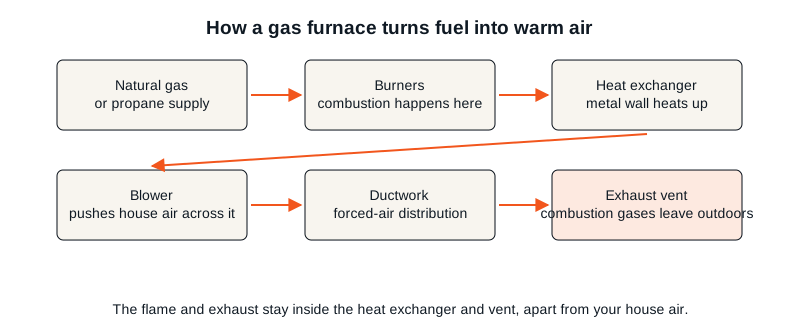
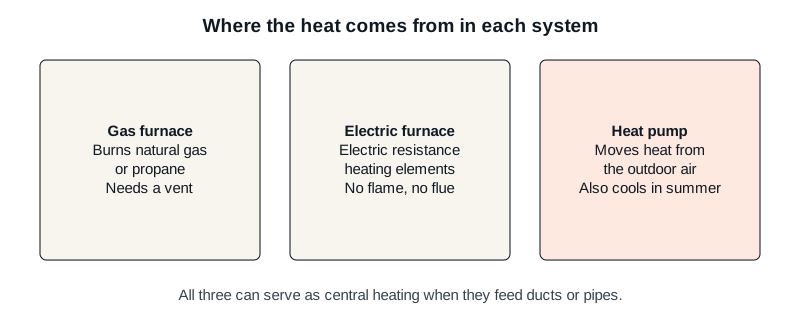
Natural gas is the usual choice wherever there's a gas line, and propane does the same job from a tank where there isn't one. Combustion happens in the burners, the flame heats a metal heat exchanger, and a blower pushes house air across the outside of it and out through the ducts. The exhaust takes a separate path through the venting. A gas boiler works the same way but warms water. Because combustion is involved, venting has to be right, and a cracked heat exchanger or a blocked vent can let exhaust gases, including carbon monoxide, where they shouldn't be. That's one reason these systems get checked by professionals.
Electric furnaces
Electric furnaces have no flame. Heating elements, a bit like the ones in a big toaster, warm the air while the blower moves it. This is electric resistance heating. You've got no gas line, no combustion and no flue, though electric power costs more per BTU of heat than gas in lots of places, and that's the trade. Electric boilers do the same with water. Space heaters and baseboard heaters work differently, because they serve one room at once, while an electric ducted system sends the power to all the rooms through the main ductwork.
Heat pumps
Heat pumps are the odd one out. They don't make heat, they move it from the outdoor air into your house, and since they move more heat than the electricity they use, they can cost less to run than an electric furnace. Backup strips cover the coldest days. Many pair with an air handler that shares the same ductwork a furnace would.
Oil and propane
Heating oil follows the same pattern as gas, with an oil tank and a burner, and you'll see it mostly in the Northeast. Mixed setups exist too: a dual fuel system pairs electric heat with a gas furnace and switches between them as the temperature changes. Gas boilers and oil boilers both feed radiators or floor pipes, and they need power for the pump and controls just like a furnace needs it for the blower.
What changes when you switch fuels
Swapping one central heating energy source for another is more than a change of equipment. A gas furnace needs a gas line to the house and proper venting to the outdoors, so a home without natural gas service means either a propane tank or a different system. An electric furnace needs no gas line and no flue, but it draws a lot of current, which means the home's electrical service has to handle it. A heat pump needs outdoor space for its condenser and usually works with the ductwork a furnace already uses. A more energy efficient choice saves money in the long run, so check what each system uses at your address.
Natural gas is the lowest-cost option in plenty of places, though not every house can get a line. Systems powered by gas or electricity can both provide steady comfort around the whole house when they're sized and maintained properly. Power is available almost everywhere, which is part of why electric furnaces and moving-heat systems show up in so many newer homes.
Before you decide, ask each installer:
- Does gas service reach the address, or would it need a propane tank?
- Can the electrical panel handle an electric furnace?
- What does each option cost per BTU at current local rates?
- Does the existing ductwork suit the new system?
What AFUE means
AFUE stands for Annual Fuel Utilization Efficiency. It's a percentage that shows how much of the energy going into a furnace ends up as heat in the house over a typical year, and the rest goes up the vent. Newer gas furnaces are often rated at 90 percent or higher, while older ones lose more. An electric furnace can post a very high AFUE because it has no flue, yet it can still cost more to run. AFUE measures how well a furnace converts its own energy. It doesn't tell you what that energy costs.
Which one costs less to run?
It depends on what your utility charges, and the only fair comparison puts both fuels in the same unit. Do the math.
| Fuel | Energy in one unit |
|---|---|
| Gas, one therm | About 100,000 BTU |
| Electric power, one kilowatt-hour | About 3,412 BTU |
Divide each price by its BTU, then adjust for how efficient your equipment is. Rates vary by region and change over time, so look at your own bills for the current price per therm and per kilowatt-hour. Gas often wins where it's cheap, electric resistance heating turns all of its power into warmth but usually costs more per BTU, and a system that moves heat can beat both in mild climates, since it relocates warmth instead of making it.
Quick questions
Does central heating use a lot of electricity?
Depends on the system. Electric furnaces and boilers use plenty, a heat pump needs less for the same amount of heat, and a gas furnace only draws a little for the blower, the igniter and the controls.
Can central heating work without electricity?
Almost never. Gas furnaces need power for the blower, igniter and board, boilers need it for the pump and controls, and it's only a few old gravity-fed systems that don't need electricity at all.
Is a heat pump central heating?
Yes, when it warms the whole house through ducts or a central air handler. It's electric heat that moves warmth instead of burning anything. Plenty of heat pumps cool the house in summer too, which is the draw of owning one machine for both seasons.
Heating out? Make the call.
Mention what you found and what the system's doing right now.